


Let us be straight about something from the off.
The sports eyewear market is enormous, and a significant chunk of it is built on the assumption that you either spend very little and accept mediocrity, or you spend a lot and get something genuinely good. There is a whole middle ground that does not get talked about enough, and that is where some of the best value in sports eyewear actually lives.
Under £60 is a realistic budget for a proper pair of sports sunglasses. Not a compromise. Not a settle. A genuinely good pair that does everything you need it to do through training, racing, and everything in between.
You just need to know what to look for. Because at this price point, the difference between a smart buy and a frustrating waste of money comes down to a handful of specific things.
UV400 Protection: Non-Negotiable
Start here. Before frame shape, before lens colour, before anything else.
As covered elsewhere on the AVN journal, UV400 protection means the lens blocks the complete UV spectrum up to 400 nanometres, covering both UVA and UVB radiation entirely. UV380 leaves a gap. No stated UV rating at all means you genuinely do not know what you are getting.
Under £60, you will find plenty of sunglasses that look sporty, feel decent in the hand, and have absolutely no confirmed UV protection to speak of. They are not worth buying regardless of how good everything else about them seems.
UV400 should be the very first filter you apply when shopping at any price point. If it is not confirmed in the specification, move on.
Frame Material: Why TR90 Is Worth Looking For
Frame material is one of those specs that gets buried in product listings but makes a genuine difference in how a pair of sunglasses performs and lasts.
At the under £60 price point, TR90 thermoplastic is the material you want to see. It is lightweight, which matters over long sessions when any unnecessary weight becomes noticeable. It is flexible, meaning it absorbs impact and bends rather than snapping under pressure. And it is durable enough to handle the kind of daily use that training kit tends to get put through.
The alternative at lower price points is often cheaper, harder plastic that is heavier, less forgiving, and more likely to crack if the frame gets knocked or sat on. It might look identical on a product photo but it behaves very differently in use.
Both the AVN Aero and Atlas use TR90 frames. At £44.99, that is the kind of material specification you would typically expect to pay more for.
Lens Material: Polycarbonate Over Everything
The lens material matters as much as the frame, arguably more so given that it sits directly in front of your eyes.
Polycarbonate, or PC, is the lens material of choice for sports eyewear across all price points. It is significantly more impact resistant than standard optical plastic, which means it handles the drops, knocks, and general chaos of being part of your training kit without shattering. It is also lighter than glass, which keeps the overall weight of the frame down.
At under £60, you want to confirm the lens is polycarbonate rather than a generic plastic material that the listing conveniently does not specify. If the material is not mentioned at all, that is usually telling you something.
Anti-Slip Fit: The Feature That Separates Sports Frames from Everything Else
This is where a lot of affordable sports sunglasses fall short, and it is also where the difference between a sports frame and a fashion frame dressed up as a sports frame becomes obvious.
Proper anti-slip performance requires rubber or silicone at the contact points. Specifically, the nose piece and the temple arms. These are the two areas where the frame meets your skin, and they are also the two areas where sweat accumulates fastest during exercise.
Hard plastic on sweaty skin does not grip. Rubber on sweaty skin does. It is a simple material difference with a significant real-world effect.
Look for anti-slip temple arms with a rubber tip or rubberised coating, and a nose piece made from rubber or silicone rather than hard plastic. An adjustable nose strap is even better, as it lets you set the fit specifically for your face rather than relying on a fixed bridge that may or may not suit your nose shape.
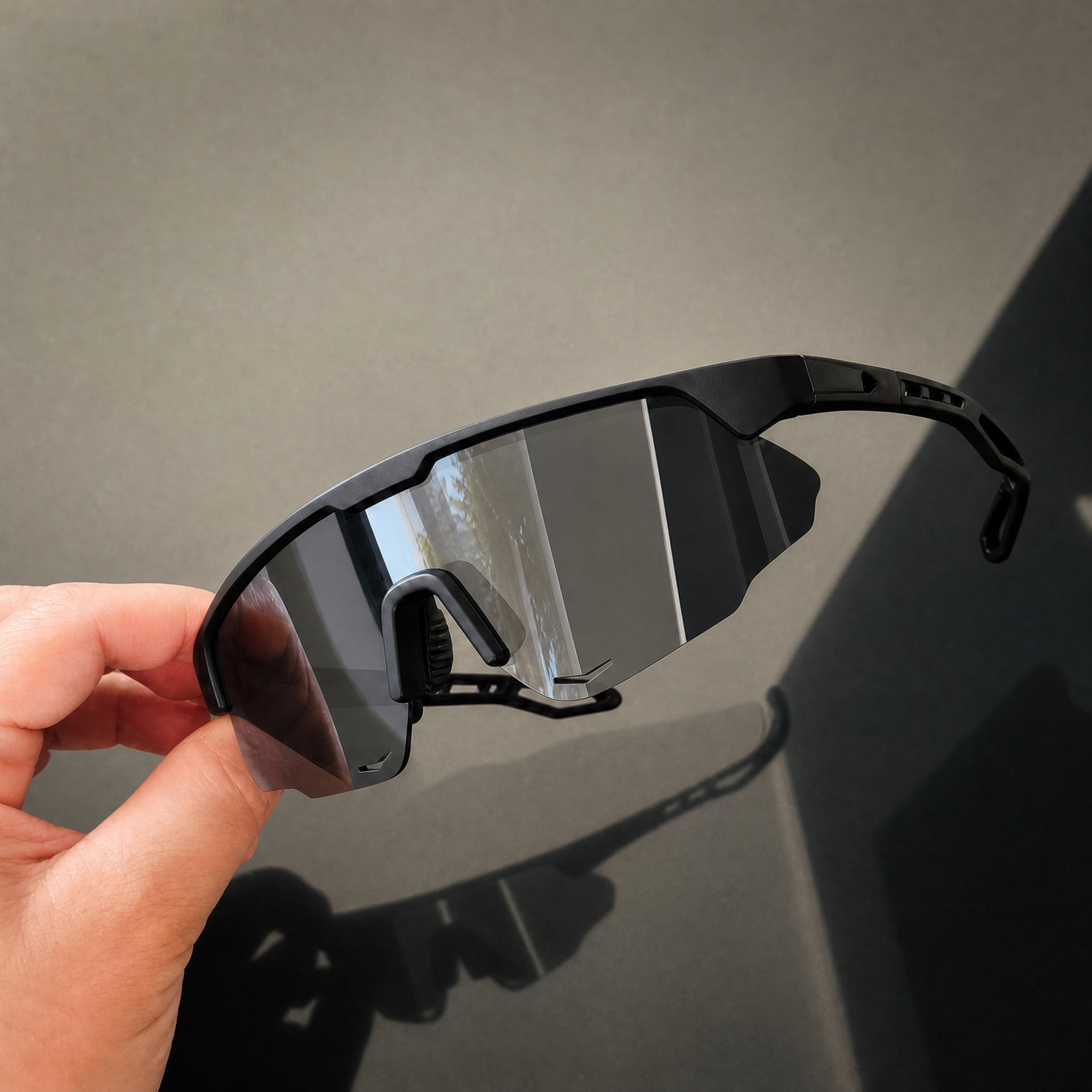
The AVN range includes anti-slip temple arms and rubber nose pieces across all three styles. At this price point, that level of fit engineering is not always a given, so it is worth specifically checking before you buy.
Frame Width: Getting the Fit Right
A sports frame that does not fit properly will never perform properly, regardless of how good the materials are or how well the lens is specified.
Frame width is the measurement that most people overlook when buying sunglasses online, and it is also one of the most important. Too wide and the frame sits loosely, moving around with every stride. Too narrow and it pinches, creating discomfort that will have you taking the sunglasses off halfway through a session.
Most product listings will include a total frame width measurement. Use it. As a general guide, most adults fall somewhere between 130mm and 145mm for face width, which means a frame width of roughly 130mm to 150mm tends to sit well for average face shapes. Broader face shapes will want to look at wider frames, and the Atlas at 168mm is a good example of a frame designed with that in mind.
Do not skip this step. A well-specified pair of sunglasses in the wrong size is still the wrong pair of sunglasses.
Lens Colour for Your Training Environment
Once the core specifications are sorted, lens colour is where you can start to match the eyewear to how and where you actually train.
Grey and smoke lenses are the most versatile option for general road running and cycling in mixed conditions. They reduce brightness without distorting colour and handle most situations reasonably well.
Mirrored lenses are at their best in bright, sunny conditions. They reduce overall light transmission by reflecting it away rather than absorbing it, which makes them particularly effective in direct sunlight, open environments, and anywhere with high reflective glare.
Revo lenses offer a similar benefit to mirrored with added colour accuracy, and they cover a broader light spectrum which makes them useful across a wider range of conditions.
If you train in one consistent environment, pick the lens suited to that. If your training varies across seasons and conditions, a mirrored or revo option tends to offer the most flexibility.
What You Can Comfortably Ignore
Not everything on a sports eyewear listing is worth paying attention to, and some features get flagged up prominently precisely because the more important stuff is not there.
Polarisation is useful but not essential for every type of training. If you run predominantly on roads or near water, it adds genuine value. If you train on trails or in controlled environments, it is a nice extra rather than a must-have.
Interchangeable lenses sound practical but add complexity and cost. Unless you are training across genuinely extreme lighting conditions on a very regular basis, a well-chosen fixed lens will handle the vast majority of what you need.
Branded packaging, case quality, and the number of accessories included are all things that have nothing to do with how the sunglasses actually perform. A great pair in a basic case is still a great pair.
The Checklist
Before buying any sports sunglasses under £60, run through these quickly:
UV400 protection confirmed in the specification. Polycarbonate lens material. TR90 or comparable lightweight frame material. Rubber or silicone at the nose piece and temple arms. Frame width that suits your face shape. Lens colour suited to your main training environment.
If a pair ticks all of those, you have got a proper sports frame at a price that makes sense. Everything else is detail.
The AVN Aero and Atlas sit at £44.99 and the Elite at £54.99. Both come in under the £60 mark and both meet every point on that list. That is not a coincidence. It is the whole point.
Under £60 is not a budget. It is a sensible place to buy sports eyewear when you know what you are looking for. The brands charging three times that are mostly selling you a logo. The kit underneath it is often doing the same job.
Know your specs. Buy what works. And go and get some miles in.


Leave a comment
This site is protected by hCaptcha and the hCaptcha Privacy Policy and Terms of Service apply.