

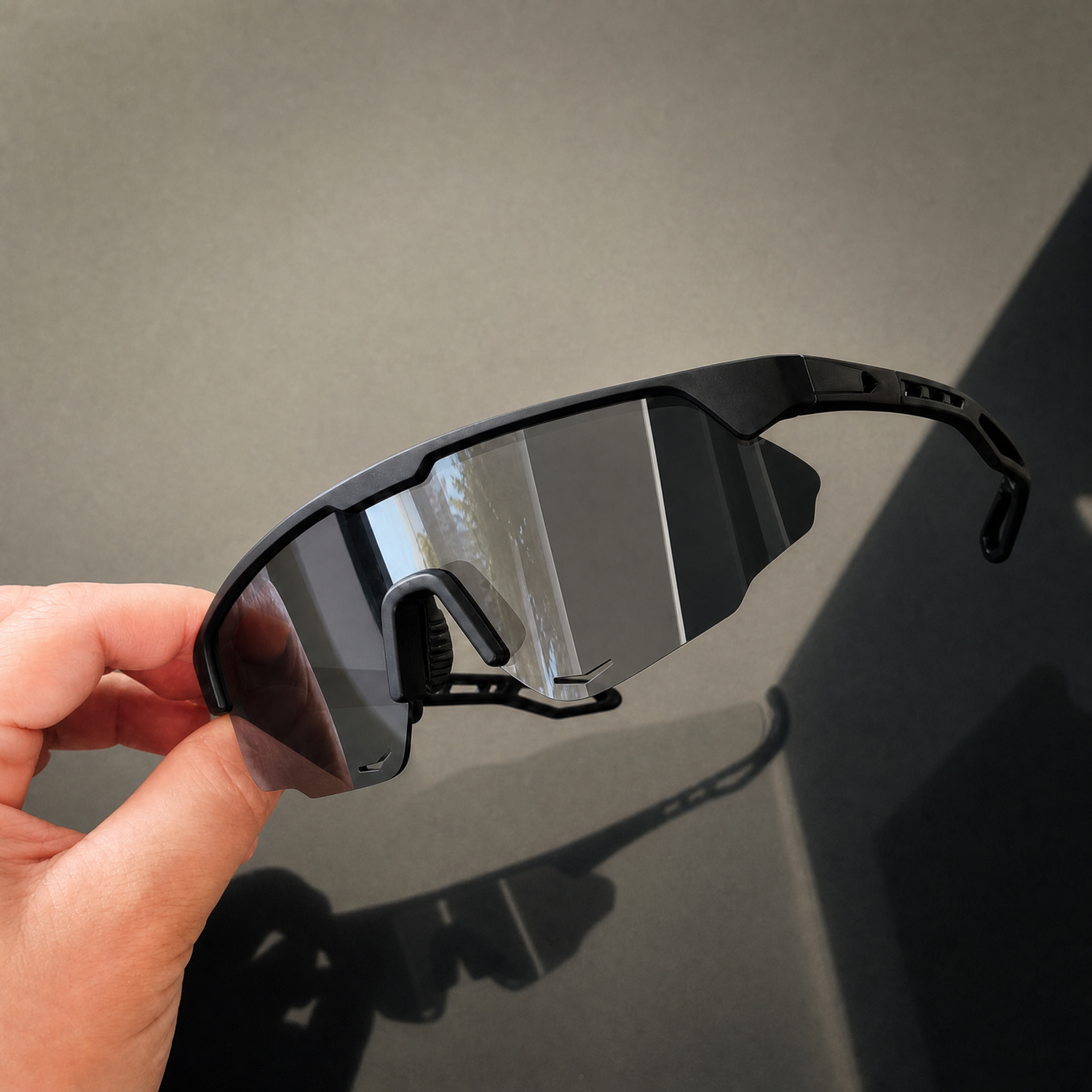
Why Do Your Sunglasses Keep Slipping?
We've all been there.
You set off feeling good. The pace is right, the playlist is sorted, and then about ten minutes in your sunglasses start their slow descent down your nose. You push them back up. Five minutes later, same thing. By the halfway point you're spending more mental energy on your eyewear than your actual run.
It's a small thing. But small things have a habit of getting very annoying, very quickly when you're already putting your body through its paces.
So why does it actually happen, and more importantly, what can you do about it?
The Sweat Problem
Let's start with the most obvious culprit: sweat.
When you train, you sweat. And sweat on your nose bridge and temples creates a slippery surface that most standard frame materials simply cannot grip. The harder you push, the more you sweat, and the more your sunglasses slide. It becomes a bit of a vicious cycle.
A lot of cheaper sports frames use hard plastic across the nose piece and temple arms. Hard plastic on sweaty skin is about as secure as a bar of soap on a wet floor. It looks fine when you're standing still. The moment you start moving at any real pace, it is a different story entirely.
This is exactly why proper sports eyewear uses rubber or silicone on the contact points rather than hard plastic. Rubber grips under pressure. It gets more secure as conditions get sweatier rather than less. It is a small design detail that makes an enormous practical difference on a run.
The Wrong Fit for Your Face
Here is one that people do not always consider: the frame might just not be right for your face shape.
A frame that is too wide will sit loosely across your face and shift around with every head movement. A frame that is too narrow will pinch, create pressure points, and eventually get pushed out of position by the discomfort alone. Neither is doing you any favours.
Getting the frame width right is genuinely important for a secure fit. The temple arms should sit flush against the sides of your head without squeezing, and the lens should sit at a natural height without sitting too low or too high on your face.
The three styles in the AVN range cover different frame widths precisely for this reason. The Aero sits at 158mm, the Atlas at 168mm for a broader fit, and the Elite at 146mm for a more refined silhouette. Different faces, different needs. Getting the right width sorted before you buy is half the battle.
The Nose Bridge Issue
The nose bridge is where a lot of sunglasses lose the plot entirely.
A fixed, hard nose bridge looks clean and minimal but it only really works for one nose shape. If your nose bridge sits higher or lower than the frame was designed for, the whole frame tilts, sits unevenly, or constantly tries to slide forward because it has no real anchor point.
An adjustable rubber nose strap or a soft rubber nose pad that moulds to your shape is a much more practical solution for active use. It gives the frame a proper grip point that is specific to your face rather than a generic assumption about what your nose looks like.
The AVN Aero and Atlas both feature an adjustable rubber nose strap that you can set once for your specific fit. The Elite uses a rubber nose pad designed to sit comfortably across all nose shapes. Both approaches solve the same problem: giving the frame a secure, personalised anchor so it stays where you put it.
Temple Arms That Do Not Actually Grip
The temple arms are the long bits that run over your ears and along the sides of your head. On a standard pair of sunglasses they are there to hold the frame in place through basic tension. On a proper sports frame, they need to do a bit more than that.
If the temple arms on your sunglasses are straight, hard plastic with no grip, they will slide along your skin during movement. The more you move your head, the more they shift. Running involves a lot of head movement, even when you feel like you are keeping everything controlled.
Anti-slip temple arms with a rubber tip or rubberised coating grip the sides of your head and keep the frame anchored through movement. It is one of those features that you genuinely notice the absence of once you have trained in a pair that has them.
You Are Wearing Them Too Low
This one sounds almost too simple but it is worth saying.
A lot of people naturally push their sunglasses slightly lower on their nose out of habit. On a regular pair of specs it does not matter much. On a sports frame during a run, starting position matters. If the frame is already sitting slightly low before you set off, it has nowhere to go but further down.
Make sure your sunglasses are sitting high and flush on your nose before you start. Push them up, make sure the nose piece is properly seated, and check the temple arms are sitting snugly along the side of your head. A thirty second adjustment before you set off can save you a dozen annoying mid-run readjustments later.
Your Sunglasses Were Not Built for Sport
Here is the honest truth about a lot of slipping sunglasses: they were never actually designed for sport in the first place.
Fashion sunglasses are built to look good while you are standing still. The materials, the fit, and the design priorities are all geared around aesthetics rather than performance under movement. There is nothing wrong with that for everyday wear. But asking a fashion frame to perform on a run is like wearing a pair of smart shoes on a trail. They might manage for a while, but they were not made for it.
A proper sports frame is built around the specific demands of movement. The materials grip under sweat. The nose piece accounts for varied face shapes. The temple arms are designed to hold position rather than just balance. The weight is kept low so the frame does not shift under its own momentum when you accelerate or change direction.
The difference in how they perform on a run is significant. If your current sunglasses keep slipping and they are not specifically a sports frame, that is probably your answer right there.
The Fix
To sum it all up, slipping sunglasses usually come down to one or more of these things: the wrong materials at the contact points, the wrong frame size for your face, a nose bridge that does not suit your shape, or a frame that simply was not built for the job.
The good news is that all of these are solvable. Get the frame width right for your face. Make sure the nose piece has some flexibility or adjustment. Check that the temple arms have a rubber grip rather than hard plastic. And make sure the frame you are buying was actually designed with sport in mind rather than just marketed that way.
Sort those things and your sunglasses will stay exactly where you put them, from the first kilometre to the last.
Which is honestly one less thing to think about on a run. And that is always a good thing.


Leave a comment
This site is protected by hCaptcha and the hCaptcha Privacy Policy and Terms of Service apply.